


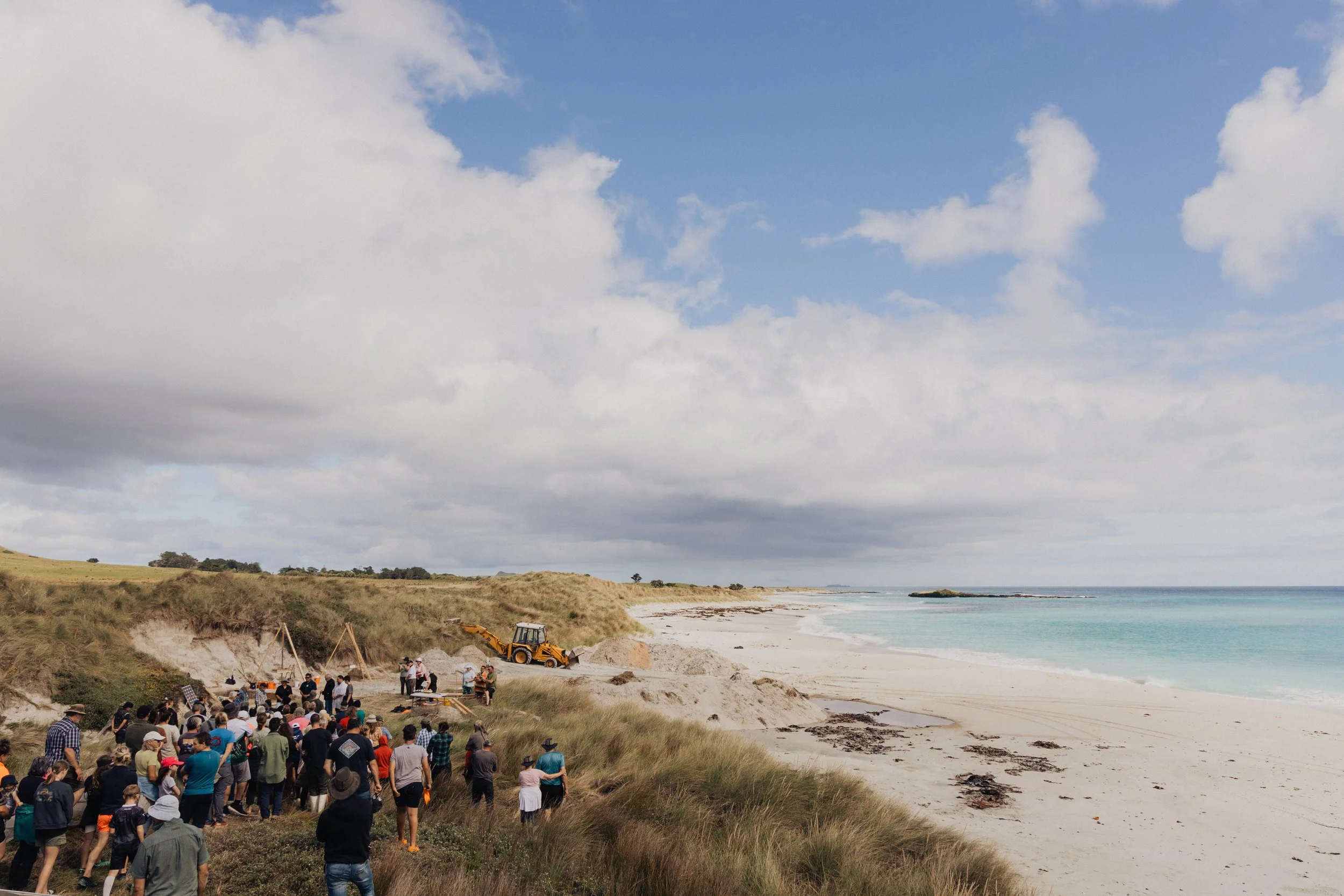

The Government is being urged to fund the recovery and preservation of an ancient waka discovered on Rēkohu Chatham Islands, as concern grows that an extraordinary piece of ancestral voyaging history could be lost to the sea.
Te Pāti Māori MP Tākuta Ferris is calling for government support for the recovery of the Rangihoua waka, described in his statement as around 550 years old, after its discovery at the mouth of the Rangihoua Stream on the northern coast of Rēkohu.
The waka was uncovered in 2024 at the archaeological site known as CH744, within the coastal area of Tē Tūtaitei Awanui.
Radiocarbon analysis of associated short-lived fibre material has produced dates largely between 1440 and 1470, although archaeologists have cautioned that the waka itself could be considerably older.
For Moriori, the discovery has profound significance.
Moriori accounts record the arrival of the large voyaging waka Rangimata and Rangihoua at Rēkohu, with Rangihoua said to have departed Hhiawaiki unfinished before being wrecked on the northern coastline after reaching the island.
The location of the archaeological discovery closely corresponds with those traditions.
Hokotehi Moriori Trust says the waka provides a physical connection between Moriori today and their karāpuna, carrying evidence of voyaging knowledge, cultural continuity and ancestral relationships with the moana and henu.
Archaeological work has also uncovered other significant material at the site, including rope dated to before 1415 and a bottle gourd that may pre-date 1400 — the first known example found on Rēkohu.
Recovering an ancient waterlogged waka is far more complicated than simply lifting it from the sand.
Timber preserved for centuries in wet conditions can rapidly deteriorate once exposed to air. Specialist conservation can require years of controlled treatment to prevent the wood shrinking, cracking or collapsing as it dries.
New Zealand conservators have previously used polyethylene glycol to gradually replace water within ancient waterlogged waka timber during preservation work.
Ferris is now putting the responsibility on the Government to ensure sufficient funding is available to protect the Rangihoua discovery.
His call raises the question of whether nationally significant taonga discovered in remote communities should depend on local organisations finding the resources needed for highly specialised archaeological recovery and conservation.
The waka also sits within a formal process under the Protected Objects Act.
Both the Moriori Imi Settlement Trust and Hokotehi Moriori Trust have lodged ownership claims on behalf of Moriori, while Ngāti Mutunga o Wharekauri Trust has also lodged a claim. Where ownership cannot be resolved through the statutory process, the matter can ultimately be referred to the Māori Land Court.
Those questions are separate from the immediate challenge of physically protecting the archaeological remains.
Whatever the eventual determination around ownership, the discovery represents an exceptional surviving connection with the voyaging technologies and communities of early Polynesian settlement in Rēkohu.
For Ferris, the argument is that the Crown should help ensure the waka survives long enough for that story to be preserved.
After centuries beneath the sands of Rēkohu, Rangihoua has emerged again — and the challenge now is making sure one of Aotearoa’s remarkable ancestral waka does not disappear for a second time.
#WaateaNews #RadioWaatea #Rangihoua #RangihouaWaka #Rekohu #Rēkohu #ChathamIslands #Wharekauri #Moriori #TakutaFerris #TePatiMaori #TePātiMāori #Waka #WakaHourua #Taonga #Karapuna #Heritage #Archaeology #IndigenousHistory #PolynesianVoyaging #Matauranga #Mātauranga #CulturalHeritage #MorioriHistory #MaoriNews #MāoriNews #TeAoMāori #Aotearoa #NZPolitics #NZNews


