

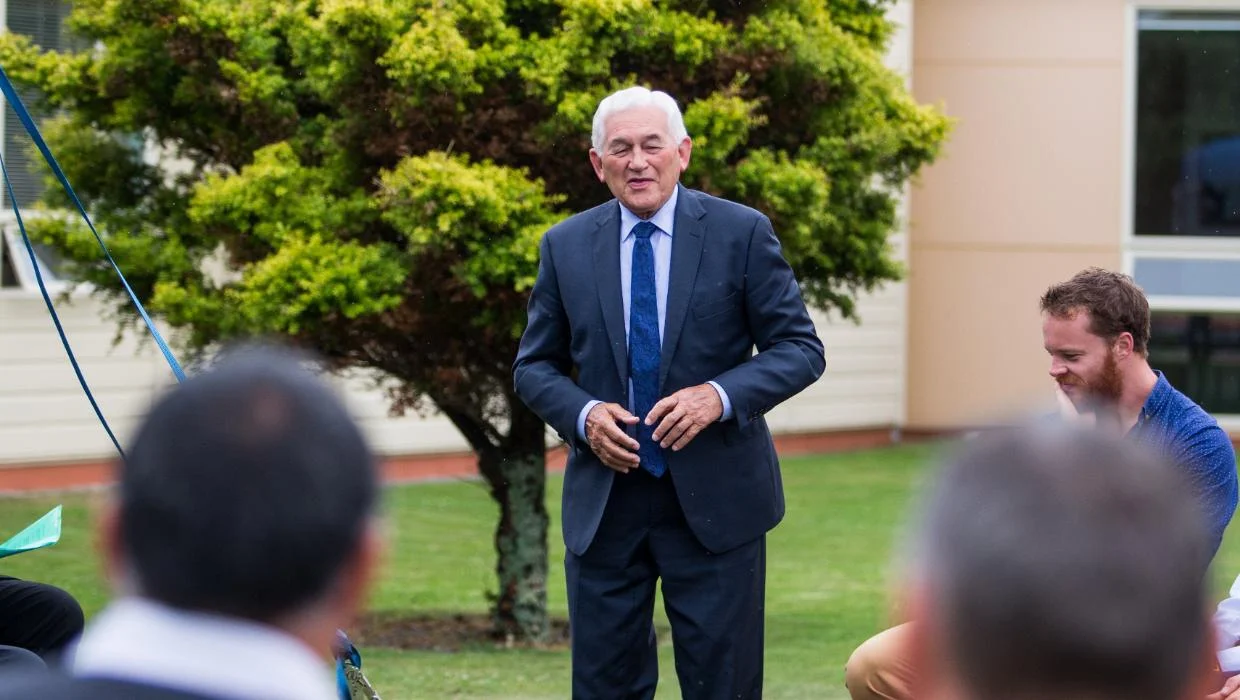


There are people whose lives can be neatly summarised by the positions they held, the organisations they represented and the battles they fought.
Rihari “Dick” Dargaville was never going to fit neatly into anything.
He was a Hokianga kaumātua, Ngāpuhi leader, Vietnam veteran, Māori advocate, campaigner and relentless champion for Te Tai Tokerau. But he was also something increasingly rare in public life.
Dick was a character.
A real one.
And the world needs characters. People who ring you with an idea that simply cannot wait until tomorrow.People who can turn a discussion about housing into an hour-long conversation in which housing somehow never gets mentioned. People who argue, laugh, scheme, challenge, advocate and occasionally drive you completely mad — but always because there is something they believe needs doing.
Dick has now passed away.
And the world is a little less interesting because of it.
The cafés and bakehouses of the North
I had often met with Dick in cafés and bakehouses up and down the North. Sometimes we talked about Agent Orange and Vietnam. Other times it was housing. Sometimes it was Donna Hall and the New Zealand Māori Council. And often we simply talked about Te Tai Tokerau. We had long conversations about the law and the lore. With Dick, the distinction between the two could become an entire conversation in itself.
But whatever direction the kōrero travelled, he had two remarkably consistent goals. The aspirations of the people of the North. And the aspirations of Māori. Everything else tended to orbit around those two things. The issue might change. The Government might change.
The campaign might change. The location of the bakehouse might change. But those two kaupapa rarely did.
An entrepreneurial solution finder
I think it is also fair to say Dick was a very entrepreneurial solution finder. That might be the diplomatic description. Over the years there were hundreds of texts, messages, calls and ideas. Some were completely serious. Some were ambitious.
Some were probably impossible. And every now and again there would arrive an absolute pearler. One message in particular remains with me:
I have the solution to housing, call me.
So I called.
My phone records tell me the conversation lasted more than an hour.
I can also tell you with some confidence that not once during that hour did we discuss housing.
That was Dick.
Somehow, the solution to housing had taken us somewhere else entirely.
There was probably a discussion about Māori rights.
Almost certainly something about the North.
Possibly a legal argument.
Maybe a new idea.
And probably another kaupapa that needed fixing immediately.
Housing would have to wait.
He stood with us
Dick and the North supported me when I was with the New Zealand Māori Council. That support mattered.But it was mutual because it was always about the kaupapa. Dick’s association with Māori Council structures was long-standing. Public records identify Rihari Dargaville with Te Kaunihera o Te Tai Tokerau, and government records also show him representing the New Zealand Māori Council in legal proceedings concerning customary marine interests.
He was also associated with the Tai Tokerau Māori Trust, representing Ngāpuhi ki Waimate. These weren’t simply names on a CV. They reflected a lifetime spent in the sometimes difficult territory where tikanga, law, politics, whenua and the aspirations of whānau meet. Dick was prepared to enter those spaces.
And he was prepared to argue.
A soldier who never stopped fighting for soldiers
Long before many of those battles, Dick had served his country. Official records of New Zealand’s Vietnam War veterans list Richard “Dick” Dargaville, service number 41269, as a Private who served in Vietnam. But Vietnam did not end for many veterans when they returned home.
Neither did it end for Dick. Decades later he remained a determined advocate for veterans and their whānau, particularly around the consequences of exposure to Agent Orange. That was one of the kaupapa we discussed many times.
It wasn’t abstract to him. These were men he had served alongside. These were families living with consequences. These were children and descendants asking questions about what had happened to their fathers and grandfathers. And Dick wanted answers.
Latterly, as Editor-in-Chief of WaateaNews.com, I have been fortunate to listen back to some of our interviews with him. There are dozens. One from May 2025 captures Dick doing what Dick did — fighting for the rights of Vietnam veterans and refusing to allow their experience to quietly disappear from public memory.
That interview remains part of the Waatea archive:
https://waateanews.com/2025/05/02/dick-dargaville-vietnam-war-veteran/
For a journalist, archives can be strange things after somebody dies. An interview recorded as news suddenly becomes something else. The voice remains.
The cadence remains. The arguments remain. The person walks back into the room for a few minutes. And there is Dick again.
The law, the lore and the takutai moana
His advocacy extended deeply into questions of customary rights and the takutai moana. Official records show Rihari representing Te Kaunihera o Te Tai Tokerau in Marine and Coastal Area applications and representing Ngāti Manawa and Kaitutae Waiariki interests in the Hokianga.
Other records identify him personally across customary marine title proceedings covering substantial parts of Te Tai Tokerau’s coastline.
Again, that was Dick.
The North wasn’t simply somewhere he lived. It was whenua. It was whakapapa. It was responsibility. He understood that decisions made in Wellington could have consequences in Whangaroa, Hokianga, the Bay of Islands and communities throughout Te Tai Tokerau. And if he thought those decisions were wrong, there was a fairly good chance somebody was going to hear from him.
Housing, poverty and the people of the North
Dick also understood something that statistics sometimes struggle to convey. Poverty looks different when you know the people living inside it. Housing shortages aren’t simply numbers when you know the whānau. Infrastructure deficits aren’t just lines in a government report when you travel the roads.
The economic challenges of Te Tai Tokerau were never theoretical for him. They were lived. That was why so many of our conversations eventually came back to development. How do we build houses? How do we create jobs? How do we make whenua work for whānau? How do Māori participate in economic development without surrendering the things that make us Māori? How does the North stop being treated as somewhere Wellington remembers only when the statistics become embarrassing? Dick might not always have arrived with the conventional solution.
Actually, he frequently didn’t. But he arrived. He had an idea. And usually another idea waiting behind it.
He wasn’t designed for the sidelines
There are people who watch history happen. Dick preferred to get involved. Sometimes that meant standing alongside the New Zealand Māori Council. Sometimes it meant advocating for veterans. Sometimes it meant customary rights. Sometimes housing. Sometimes regional development.
Sometimes ringing someone and informing them that he had solved a problem of national importance. Whether the rest of us were ready for the solution was almost beside the point. Dick wasn’t designed for the sidelines.
The North produces people like Dick
Perhaps Te Tai Tokerau itself explains something about him. The North has always produced characters. Big personalities. Storytellers. Fighters. Entrepreneurs.
Kaumātua who can move effortlessly from whakapapa to politics, from politics to business, from business to history and somehow arrive at lunch having solved three national crises along the way. Dick belonged to that tradition. He could frustrate you. He could surprise you. He could make you think. And he could make you laugh. But beneath all of it was something remarkably serious.
He cared.
He cared about Māori. He cared about Te Tai Tokerau. He cared about veterans. He cared about the rights of whānau. He cared about the future. And he cared enough to keep turning up.
A character until the end
Obituaries have a tendency to smooth people out. We take complicated, colourful human beings and make them respectable. We list the organisations.
We mention the achievements.We describe a lifetime of service. And sometimes, in doing that, we accidentally remove the very things that made the person unforgettable. I don’t want to do that to Dick.
Because Dick was Dick.
The messages.
The phone calls.
The meetings in cafés.
The bakehouses.
The ideas.
The law.
The lore.
Vietnam.
Agent Orange.
Housing — even when we didn’t actually discuss housing.
Donna Hall.
The Māori Council.
The North.
Always the North.
Always Māori.
Those things were part of the man.
And I am grateful for those conversations.
I am grateful for the support he and the North gave me.
I am grateful that, years later, Waatea still has his voice sitting in our archive, fighting for the things he believed in.
And I am grateful to have known one of Te Tai Tokerau’s great characters.
The world is less without him
Rihari “Dick” Dargaville has now gone. There will be serious tributes to the kaumātua. To the veteran. To the advocate. To the Māori leader. To the man who spent decades pushing the aspirations of Te Tai Tokerau and Māori. All of them will be deserved. Mine is perhaps a little simpler.
Dick was a real character.
The world needs characters.
People with ideas. People with courage. People prepared to challenge things. People who refuse to quietly accept that something cannot be done simply because nobody has figured out how to do it yet. People who send you a message saying they have solved housing — and then spend the next hour talking about absolutely everything except housing. I will miss those calls. I will miss those conversations. And Te Tai Tokerau will miss one of its great advocates.
The world is less because Dick Dargaville is no longer in it.
But the North is richer because he was.
Haere rā e te rangatira.
Haere rā e te hōia.
Haere ki tua o te ārai.
Moe mai rā, e Dick.
#RihariDargaville #DickDargaville #MoeMaiRa #HaereRa #TeTaiTokerau #Hokianga #Ngāpuhi #VietnamVeteran #VietnamWar #AgentOrange #Veterans #NZVeterans #NewZealandMāoriCouncil #MāoriCouncil #TakutaiMoana #ManaWhenua #WhenuaMāori #MāoriHousing #MāoriRights #Rangatira #Kaumātua #Whakapapa #Aroha #Poroporoaki #TeAoMāori #Northland #Aotearoa #WaateaNews #RadioWaatea


