


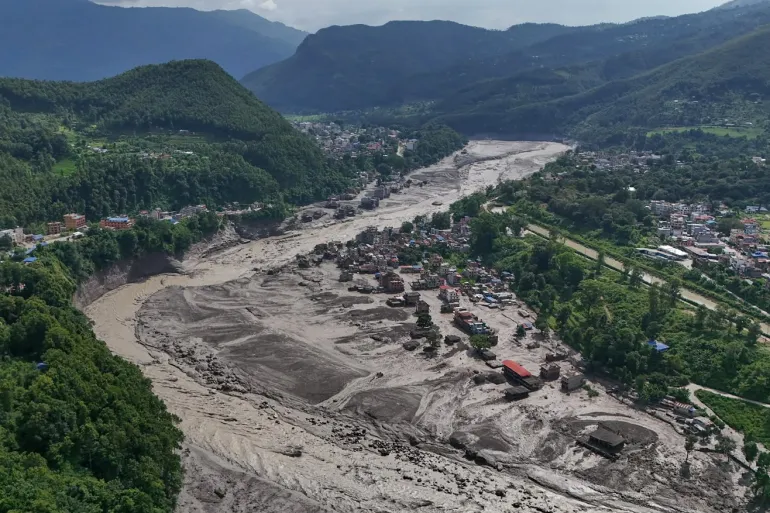

A catastrophic flash flood has devastated communities along the Nepal-Tibet border, killing at least 98 people and leaving hundreds missing after a torrent of water, mud and rock swept away villages, roads, bridges and power infrastructure.
The scale of the disaster has escalated rapidly since the first reports emerged on Wednesday, with Nepalese authorities confirming at least 95 deaths, while Chinese authorities have reported another three deaths across the border in Tibet.
Hundreds of people remain unaccounted for, triggering a major international search and rescue operation across the Himalayan region.
Hundreds of tourists missing
Nepalese officials say at least 384 tourists and travellers have been reported missing, including hundreds of international visitors.
Authorities say the missing include travellers from countries including India, the United Kingdom and the United States, while South Korea has confirmed eight of its nationals working on a hydropower project are also missing.
Across the border, Chinese authorities say 265 people remain missing in Tibet’s Gyirong county, where the disaster has also destroyed roads and disrupted electricity and communications.
The full death toll remains uncertain as rescuers struggle to reach isolated communities.
Entire villages swept away
The flood struck with extraordinary force through mountain valleys, sending enormous volumes of muddy water and debris downstream.
Homes, schools, bridges, highways and infrastructure projects have been destroyed, with reports of entire settlements being swept away.
The mountainous Rasuwa district, home to around 50,000 people, is among the worst affected areas.
Conditions have made rescue operations extremely difficult, with floodwaters preventing helicopters from landing in some communities including Syapru Besi and Timure.
Residents along the Bhote Koshi River have been told to move to higher ground amid continuing fears of further flooding.
Nepal has asked both India and China for assistance with the rescue operation.
What caused the disaster?
The exact sequence of events remains under investigation, but emerging evidence suggests this was not a conventional rain-driven flash flood.
Climate and disaster specialists are investigating whether an ice-and-rock avalanche from a glacier crashed into the Lhende Khola river system, temporarily blocking water before unleashing a sudden destructive surge downstream.
Satellite analysis has also pointed towards a landslide of snow and rock triggering the debris-filled flood near the Nepal-China border.
That could help explain why some communities were caught by surprise despite there being no corresponding extreme rainfall immediately before the disaster.
Scientists and authorities are continuing to investigate the cause.
Power system badly damaged
The destruction is also having major consequences for Nepal’s electricity system.
The Nepal Electricity Authority estimates around 430 megawatts of electricity generation capacity has been damaged, including hydropower and solar infrastructure.
Production, transmission and distribution facilities have all been affected, causing electricity disruptions.
Roads and bridges have also disappeared, potentially leaving some isolated communities difficult to reach for an extended period.
Fears floodwaters could reach India
The emergency is now extending downstream.
Authorities in the northern Indian state of Bihar have begun evacuating people from six districts amid concerns rising waters could move from Nepal into India.
Thousands have already been moved as authorities prepare communities along vulnerable river systems.
The Bhote Koshi flows into Nepal’s Trishuli River before eventually reaching India as the Gandak River, connecting the disaster across national borders.
Himalayan communities confronting growing risk
The disaster again highlights the extreme vulnerability of communities living beneath the glaciers and steep valleys of the Himalayas.
The same Bhote Koshi river system experienced a deadly flood last year that killed nine people, left 24 missing and destroyed the Friendship Bridge connecting Nepal and China.
That event was linked to the sudden draining of a glacial lake in Tibet.
Scientists have repeatedly warned that climate change is altering glaciers and increasing environmental risks across the Himalayan region, while extreme weather events are becoming more intense across parts of South Asia.
But determining exactly how climate factors contributed to this particular disaster will require further scientific investigation.
Search for survivors continues
Nepal’s military has deployed helicopters and disaster-response personnel, while medical teams, the Red Cross and other emergency organisations have joined the response.
China has also mobilised hundreds of personnel and rescue vehicles on its side of the border.
For now, the priority is finding those still missing.
With roads destroyed, communities isolated and hundreds of people still unaccounted for, authorities fear the death toll could continue to rise.
For communities along the rivers of the Himalayas, Wednesday’s disaster arrived with devastating speed — turning rivers into torrents, sweeping away generations of homes and leaving families across several countries waiting for news of their missing loved ones.
#Nepal #NepalFloods #Tibet #FlashFloods #Himalayas #Rasuwa #BhoteKoshi #TrishuliRiver #Flooding #NaturalDisaster #ClimateChange #ClimateCrisis #Glaciers #GlacialFlood #ExtremeWeather #DisasterResponse #SearchAndRescue #India #China #SouthAsia #Bihar #ClimateResilience #InternationalNews #WorldNews #Aotearoa #MāoriNews #WaateaNews #RadioWaatea #WaateaDigital


